


About 2,000 people, including migrant workers, rights activists, unionists and college students, took to the streets in Taipei yesterday, calling on the government to better protect the rights of migrant domestic workers by giving them regular days off and establishing a minimum wage.
Holding up signs that read “Where are my days off?” in Indonesian, Thai, Vietnamese and Tagalog, the migrant workers and their Taiwanese supporters said that they wanted to have vacation time as they began their march at the Zhongxiao Fuxing MRT station.
“In 2007, migrant workers took to the streets for the first time, shouting: ‘I want days off.’ In 2009, they did it again, shouting: ‘I still don’t have any days off,’” Taiwan International Workers’ Association chairperson Lorna Kung (龔尤倩) told the crowd.
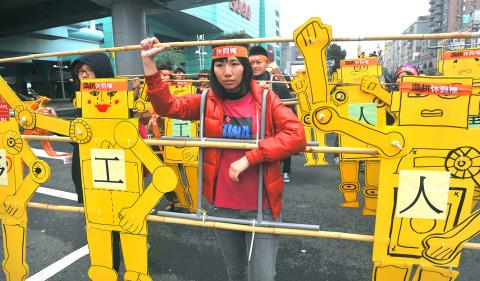
Photo: Patrick Lin, AFP
“This year, unfortunately, migrant workers have to come out again and ask: ‘Where are my days off?’” she said.
“Hopefully, next time when they’re out on the streets, they are there to thank their Taiwanese supporters for giving them a hand in their struggle for holidays.” Kung said.
Wang Wen-hsiu (王文秀), a specialist from the Presbyterian Church in Taiwan Labour Concerns Centre, which is a member organization of the Migrant Empowerment Network in Taiwan, said that of the 200,000 foreign domestic workers in the country, only 5.5 percent could have regular days off on public holidays and weekends. Moreover, as many as 42.4 percent of foreign domestic workers have not had a single day off this year, Wang said.
“On average, they work 13 hours a day and their passports are usually taken by their Taiwanese employers. They are also under the constant threat of being fired and sent home,” Wang said. “So most of them don’t dare to resist because, in order to come to Taiwan, they’ve borrowed a large amount of money — something like NT$200,000 — and they need to make money to pay back that debt.”
A migrant worker from Vietnam surnamed Nguyen told the Taipei Times that during the nine years she has worked in Taiwan as a domestic caregiver, she has had almost no days off. Nguyen said she works more than 10 hours a day and that her passport was taken by her employer on her first day of work.
“For the first two or three years, I worked with no income since almost all of my wages were used to pay back the bank loan I took out so I could get to Taiwan,” she said.
Although the Council of Labor Affairs recently drafted a bill regarding domestic workers with clauses that would give foreign domestic workers days off, Kung said they were virtually useless since, according to the draft bill, the days-off rule could be changed during negotiations between the employer and the foreign worker.
“Finding themselves in such a difficult position, what foreign domestic worker could negotiate with his or her employer on an equal footing?” Kung asked.
Besides questioning the government’s efforts, Kung called on Taiwanese employers to give foreign domestic workers a break.
“Most foreign domestic workers take care of the elderly and the physically challenged, but only when they have had enough rest can they provide quality care for the needy in your family,” she said.
Only when migrant workers are paid the same as Taiwanese workers can the latter stop worrying that their jobs will be taken by foreign workers, she said.
“Workers should stand united and Taiwanese workers should help migrant workers get equal pay,” Kung said. “Because when migrant workers receive a lower wage, the employer will always want to hire migrant workers and take away your jobs.”

The National Chungshan Institute of Science and Technology yesterday showcased its locally developed variants of the Vision 60 robotic patrol dog, which it plans to deploy on the nation’s outlying territories in the South China Sea. The variants were produced under the Joint Lab project — created by the institute and domestic companies — and assembled with domestically produced motors, lenses and artificial intelligence (AI) systems alongside licensed tech from the US, Missile and Rocket Systems Research Division deputy director Jen Kuo-kang (任國光) told the media event at a military base in Taipei’s Dazhi (大直) area. Taiwan has built up its strengths

RIGHT DIRECTION: Taiwan’s efforts to prevent forced labor include a proposal to ‘fully prohibit’ employers from withholding workers’ documents, an official said Taiwan is to establish a mechanism to restrict imports of goods linked to forced labor, the Executive Yuan said yesterday, after the US proposed imposing additional tariffs on Taiwanese goods over labor concerns. “The Ministry of Labor and the Ministry of Economic Affairs are to establish an interministerial review procedure,” Executive Yuan spokesperson Michelle Lee (李慧芝) said at a news briefing in Taipei. “The government is to use the Foreign Trade Act [貿易法] as the legal basis to restrict imports of goods produced with forced labor” and bring its supply chain governance more in line with international standards on human rights, resilience

NOT IMMEDIATE: Taiwan has a chance to appeal the proposed 10 percent tariff before it starts, while other countries face a 12.5 percent tariff from the trade office Taiwan is among 60 economies determined by the US to have failed to impose or enforce a ban on the importation of goods produced with forced labor, according to a notice released on Tuesday by the Office of the US Trade Representative (USTR), which proposed imposing an additional 10 percent or more tariff on them. The USTR in a statement said that following an investigation, it had determined under Section 301 of the Trade Act of 1974 that the failure of the 60 economies to impose and effectively enforce a prohibition on the importation of goods produced with forced labor is

TIT-FOR-TAT: The US allegedly revoked the visa of a Chinese national working at Xinhua News Agency in the US in response to Beijing’s expulsion of Vivian Wang The Presidential Office yesterday condemned China for expelling a New York Times correspondent from Beijing following the newspaper’s interview with President William Lai (賴清德), saying the move highlighted Beijing’s suppression of press freedom and its threat to international news media. Taiwan has noted a series of recent incidents in which Beijing used similar tactics to “threaten and pressure international media outlets and journalists,” Presidential Office spokeswoman Karen Kuo (郭雅慧) said in a statement. “This concerns not only press freedom and freedom of expression, but also the safety of journalists, and Taiwan and relevant partners are paying close attention to the situation,” she


 RSS
RSS